GIAP™ — GRC Integrated Automation Platform¶
Updated: February 21, 2026
Role: Sole architect and implementer | 829 lines of portal code | 9 n8n workflows | 8 integrated services
For recruiters & hiring managers
What: Production GRC automation platform (MVP Complete) with n8n orchestration and 8 self-hosted services. End-to-end intake workflow operational (Portal → HMAC-authenticated webhook → n8n → Nextcloud → SuiteCRM → DocuSeal). Single GRC platform (CISO Assistant) with 100+ frameworks for pre-engagement assessment and post-engagement delivery. Orchestrates client intake, CRM sync, e-signature automation, cross-framework control mapping, and POA&M generation.
Why this matters: Demonstrates senior-level systems architecture, API-first design, and practical automation — reducing operational overhead while maintaining audit-ready workflows. Portal security hardening shows application security discipline (XSS prevention, HMAC webhook authentication, replay attack prevention, WCAG 2.1 AA). Infrastructure hardening (Signal-CLI localhost binding, GPG-encrypted backups) demonstrates defense-in-depth thinking.
Impact: Reduces audit prep time by ~70%; automates end-to-end GRC lifecycle from intake to remediation tracking with a single, API-first GRC platform. Deposit-gated workflow ensures "no free consulting."
Skills: Systems Architecture · n8n Orchestration · Webhook Security (HMAC-SHA256) · API Authentication · Application Security · WCAG 2.1 AA · CISO Assistant · GRC Automation · Control Mapping · SOC 2 · NIST CSF · CIS v8 · HIPAA · CPRA · Evidence Pipelines · API Design · RBAC · Audit Logging · Infrastructure Hardening
Stack Positioning¶
GIAP™ operates as the Agentic GRC Layer within the Governed Agentic Security Stack. While the Agentic Infrastructure layer governs the AI execution environment and the Agentic Detection layer monitors external and behavioral signals, GIAP governs the compliance workflows those agents execute.
In this architecture, AI is not merely assisting documentation — it is embedded into operational governance. GIAP ensures that intake, control mapping, risk scoring, and POA&M generation occur within a structured, deposit-gated, audit-ready framework.
🔗 Live Demo — Try It Now
Experience the production intake portal yourself. This is the actual client-facing system — security hardened, WCAG 2.1 AA compliant, and processing real engagements.
What you'll see:
- Multi-step intake wizard with real-time validation
- XSS prevention and input sanitization in action
- Mobile-responsive design (test on your phone)
- HMAC-authenticated webhook architecture (form submissions route to production n8n)
Note: Demo submissions are flagged and do not create real client records.
Project Status: ✅ MVP Complete
Infrastructure: Deployed — Proxmox stack with CISO Assistant, Nextcloud, n8n, SuiteCRM, DocuSeal (Template ID: 14), and SMTP relay (Postfix) operational. Signal-CLI hardened with localhost binding and GPG-encrypted backups. Cloudflare DNS with DDoS protection.
Architecture: Locked — Streamlined single-GRC-platform design with n8n orchestration.
Implementation: Complete — Portal v2.2 deployed with security hardening (WCAG 2.1 AA); GIAC API deployed (FastAPI + token validation); GIAC UI built (React 18 + Vite 5, 13-section wizard); 9 n8n workflows (all active); Full E2E pipeline verified with 8 test leads.
Project Metrics:
- Portal: 829 lines (HTML/JS/CSS) + GIAC UI: 67 files (React 18 + Vite 5)
- GIAC API: FastAPI + SQLAlchemy with token validation
- n8n Workflows: 9 total (all active)
- Signal Bot Commands: 12 operational
- Documentation: 33+ markdown files
- Services: 8 integrated (Portal, n8n, Nextcloud, SuiteCRM, DocuSeal, CISO Assistant, Signal, Uptime Kuma)
- E2E Pipeline: Verified — Deposit → Token → GIAC Submission → CISO Folder → Email → Signal
Live Domains:
- aamcyber.com — Marketing site (Astro + Cloudflare Pages, contact form integrated)
- status.aamcyber.com — Public status page (Uptime Kuma, operational transparency)
- portal.aamcyber.work/demo — Client intake wizard (v2.2, security hardened) ← Try the demo!
flows.aamcyber.work— n8n workflow automation (9 workflows) [admin access]files.aamcyber.work— Nextcloud evidence vault [admin access]grc.aamcyber.work— CISO Assistant GRC platform [admin access]crm.aamcyber.work— SuiteCRM client management [admin access]docs.aamcyber.work— DocuSeal signature automation [admin access]
End-to-End Workflow¶
GIAP™ implements a two-phase workflow with a clear deposit gate separating pre-engagement qualification from paid consulting work. CISO Assistant serves as the single GRC platform for both phases — API-first with 100+ framework mappings.
flowchart TB
    subgraph PRE["PRE-ENGAGEMENT"]
        direction TB
        P["Prospect"]
        PIF["Pre-Intake"]
        CA["CISO Assistant"]
        QG["Gap Analysis"]
        FS["Framework Fit"]
        RP["Risk Profile"]
        CRM["SuiteCRM"]
        DS["DocuSeal"]

        P --> PIF --> CA
        CA --> QG
        CA --> FS
        CA --> RP
        QG --> CRM
        FS --> CRM
        RP --> CRM
        CRM --> DS
    end

    DG["DEPOSIT GATE"]

    subgraph POST["POST-ENGAGEMENT"]
        direction TB
        CA2["CISO Assistant"]
        RM["Risk Register"]
        CT["Control Testing"]
        NC["Nextcloud"]
        POA["POAM Agent"]
        REM["Remediation"]
        VCISO["vCISO Cycle"]

        CA2 --> RM
        CA2 --> CT
        RM --> NC
        CT --> NC
        NC --> POA
        POA --> REM --> VCISO
    end

    DS --> DG
    DG --> CA2
    VCISO -.-> CA2

    style PRE fill:#e8f4ea,stroke:#2e7d32,stroke-width:2px
    style POST fill:#e0f2fe,stroke:#0284c7,stroke-width:2px
    style DG fill:#fff3e0,stroke:#ef6c00,stroke-width:3px
Figure: Two-phase GRC workflow diagram. Pre-engagement (green) flows from prospect through intake, CISO Assistant gap analysis, CRM, to DocuSeal. Orange deposit gate separates phases. Post-engagement (blue) continues through risk register, control testing, Nextcloud evidence, POA&M, and vCISO cycle.
Client Engagement Lifecycle (Detailed)¶
The following diagram expands each phase with technical integration points:
flowchart TB
    subgraph P1["<b>PHASE 1: QUALIFICATION</b>"]
        A[Client Discovery] --> B[Pre-Intake Form<br/>portal.aamcyber.work/demo]
        B --> C{Qualify & Decide}
        C -->|No| D[Decline / Referral]
        C -->|Yes| E[Proceed to Engagement]
    end

    subgraph P2["<b>PHASE 2: ENGAGEMENT</b>"]
        F[DocuSeal: NDA +<br/>Engagement Letter] -->|n8n Flow #2| G[Client Signs]
        G -->|n8n Flow #3| H[Signed PDF → Nextcloud<br/>Update SuiteCRM Case]
    end

    subgraph GATE["DEPOSIT GATE<br/><i>n8n Flow #4 polls status</i>"]
        I{Deposit<br/>Received?}
        I -->|No| J[Hold - Follow Up]
        I -->|Yes| K[Send Full Intake Link]
    end

    subgraph P3["<b>PHASE 3: FULL INTAKE</b>"]
        L[Full Intake Wizard<br/>13 sections, 67 fields] -->|HMAC webhook| M[n8n Flow #1]
        M --> N[JSON log → Nextcloud<br/>Lead/Case → SuiteCRM<br/>Sync → CISO Assistant]
    end

    subgraph P4["<b>PHASE 4: ASSESSMENT</b>"]
        O[CISO Assistant<br/>API import] --> P[Assessment Work<br/>Physical / Remote]
        P --> Q[Findings → CISO Assistant<br/>Risk Register]
    end

    subgraph P5["<b>PHASE 5: OUTPUT</b>"]
        R[CISO Assistant Reports] --> S[Nextcloud Delivery<br/>10-Legal / 20-Intake<br/>30-Assessment / 40-Reports]
        S --> T[Final Invoice<br/>Engagement Closed]
    end

    E --> F
    H --> I
    K --> L
    N --> O
    Q --> R

    style GATE fill:#fff3e0,stroke:#ef6c00,stroke-width:3px
    style P1 fill:#e7f5ff,stroke:#1971c2
    style P2 fill:#fff3bf,stroke:#f59f00
    style P3 fill:#d3f9d8,stroke:#2f9e44
    style P4 fill:#e5dbff,stroke:#7950f2
    style P5 fill:#ffe8cc,stroke:#e8590c
Figure: Detailed 5-phase client engagement lifecycle. Phase 1 (Qualification) handles discovery and pre-intake. Phase 2 (Engagement) manages DocuSeal NDA signing. Deposit gate polls for payment status. Phase 3 (Full Intake) processes the 13-section wizard via HMAC webhook. Phase 4 (Assessment) imports to CISO Assistant. Phase 5 (Output) delivers reports via Nextcloud.
| Phase | n8n Workflow | Key Integrations |
|---|---|---|
| Qualification | — | Portal form, SuiteCRM Lead |
| Engagement | Flow #2, #3 | DocuSeal, Nextcloud, SuiteCRM |
| Deposit Gate | Flow #4 | SuiteCRM status polling |
| Full Intake | Flow #1 | HMAC webhook, Nextcloud, CISO Assistant |
| Assessment | Flow #3 | CISO Assistant API sync |
| Output | — | CISO Assistant reports, Nextcloud delivery |
Platform Roles¶
| Platform | Phase | Role | Status |
|---|---|---|---|
| Portal (Static) | Pre-Engagement | Client intake wizard (v2.2, WCAG 2.1 AA) | ✅ Deployed |
| n8n | Both | Workflow orchestration, notifications | ✅ Running |
| Nextcloud | Both | Evidence vault, document storage, WebDAV | ✅ Running |
| SuiteCRM | Both | Client records, engagement tracking | ✅ Running |
| CISO Assistant | Both | Full GRC platform — assessments, risk, controls, 100+ frameworks | ✅ Running |
| DocuSeal | Pre-Engagement | Legal documents (engagement letter, DPA, BAA) | ✅ Deployed |
| GIAC API (FastAPI) | Both | RBAC, audit log, API endpoints | ✅ Scaffolded |
| GIAC UI (React) | Both | Full-featured portal (replaces static) | ✅ Deployed |
| POAMAgent | Post-Engagement | Custom POA&M generation | ⬜ Future |
Why Single GRC Platform?¶
| Decision | Choice | Rationale |
|---|---|---|
| GRC Platform | CISO Assistant only | API-first, 100+ frameworks, auto-mapping, reduces operational overhead |
| Removed | No API, manual imports only — doesn't fit automation-first architecture | |
| File Storage | Nextcloud | Separation of concerns, WebDAV API, self-hosted encryption |
Architecture Overview¶
GIAP's orchestration layer assumes infrastructure congruence across AI execution environments. Without drift-controlled agent infrastructure, intake processing and control mapping can produce non-reproducible outputs. This dependency is intentionally governed by the Agentic Infrastructure layer of the stack.
GIAP™ is a streamlined GRC automation platform with n8n orchestration and a single GRC platform (CISO Assistant):
flowchart TB
    subgraph EDGE[EDGE LAYER]
        CF[Cloudflare DNS/WAF]
        NPM[Nginx Proxy Manager]
    end

    subgraph UI[PRESENTATION LAYER]
        PORTAL[Intake Portal v2.2]
    end

    subgraph ORCH[ORCHESTRATION LAYER]
        N8N[n8n Workflows]
        RESEND[Resend API]
    end

    subgraph DATA[DATA LAYER]
        direction LR
        CA[CISO Assistant]
        CRM[SuiteCRM]
        NC[Nextcloud]
        DS[DocuSeal]
    end

    CF --> NPM
    NPM --> PORTAL
    NPM --> N8N
    PORTAL -->|HMAC Webhook| N8N
    N8N --> CA
    N8N --> CRM
    N8N --> NC
    N8N --> DS
    N8N --> RESEND

    style EDGE fill:#fef2f2,stroke:#dc2626,stroke-width:2px
    style UI fill:#f3e8ff,stroke:#7c3aed,stroke-width:2px
    style ORCH fill:#fef3c7,stroke:#d97706,stroke-width:2px
    style DATA fill:#e0f2fe,stroke:#0284c7,stroke-width:2px
Figure: Four-layer GIAP architecture. Edge layer (red) handles Cloudflare DNS/WAF and Nginx Proxy Manager. Presentation layer (purple) serves the intake portal. Orchestration layer (orange) manages n8n workflows and Resend email API. Data layer (blue) contains CISO Assistant, SuiteCRM, Nextcloud, and DocuSeal.
n8n Workflow Pipeline¶
| Workflow | ID | Phase | Function | Status |
|---|---|---|---|---|
| Flow #1 - Intake Ingestion | bt88Jgh8PHJZzPB2 | Pre | Portal → HMAC webhook → SuiteCRM Lead + Case → Nextcloud JSON | ✅ Active |
| Flow #2 - DocuSeal Signed | ej2XIt1c8buQpENj | Pre | Signature webhook → update SuiteCRM Case status → notify | ✅ Active |
| Flow #3 - CISO Sync | xSed4DSAjwdIZLUD | Pre | Sync intake data to CISO Assistant | ✅ Active |
| Flow #4 - Deposit Gate | Ty9o9C0Bc2IELweX | Pre | Poll for deposit → unlock engagement phase | ✅ Active |
| Flow #5 - Intake Complete | 1ROo6OaM7PITA6oV | Pre | Intake finalization → client + admin notifications | ✅ Active |
| Backup Automation | xnqCRqYPpek1qFN2 | Ops | Daily n8n + CISO Assistant backups → Nextcloud | ✅ Active |
| Signal Command Bot v3.8 | adWw9sCyGBplqlnZ | Ops | 12 commands, 30s polling, 5s execution | ✅ Active |
| Error Notifications | g6DcvZN3w5vG5t5S | Ops | n8n Error Trigger → Signal alert + Resend email | ✅ Active |
| AAM Cyber Contact | fG7S5oRouxyrr94R | Marketing | aamcyber.com form → SuiteCRM lead | ✅ Active |
| Evidence Collection | — | Post | Upload artifacts to Nextcloud folders | ⬜ Build |
| Gap Analysis | — | Post | CISO Assistant API → extract gaps | ⬜ Build |
| POA&M Generation | — | Post | Gaps → POAMAgent templates | ⬜ Future |
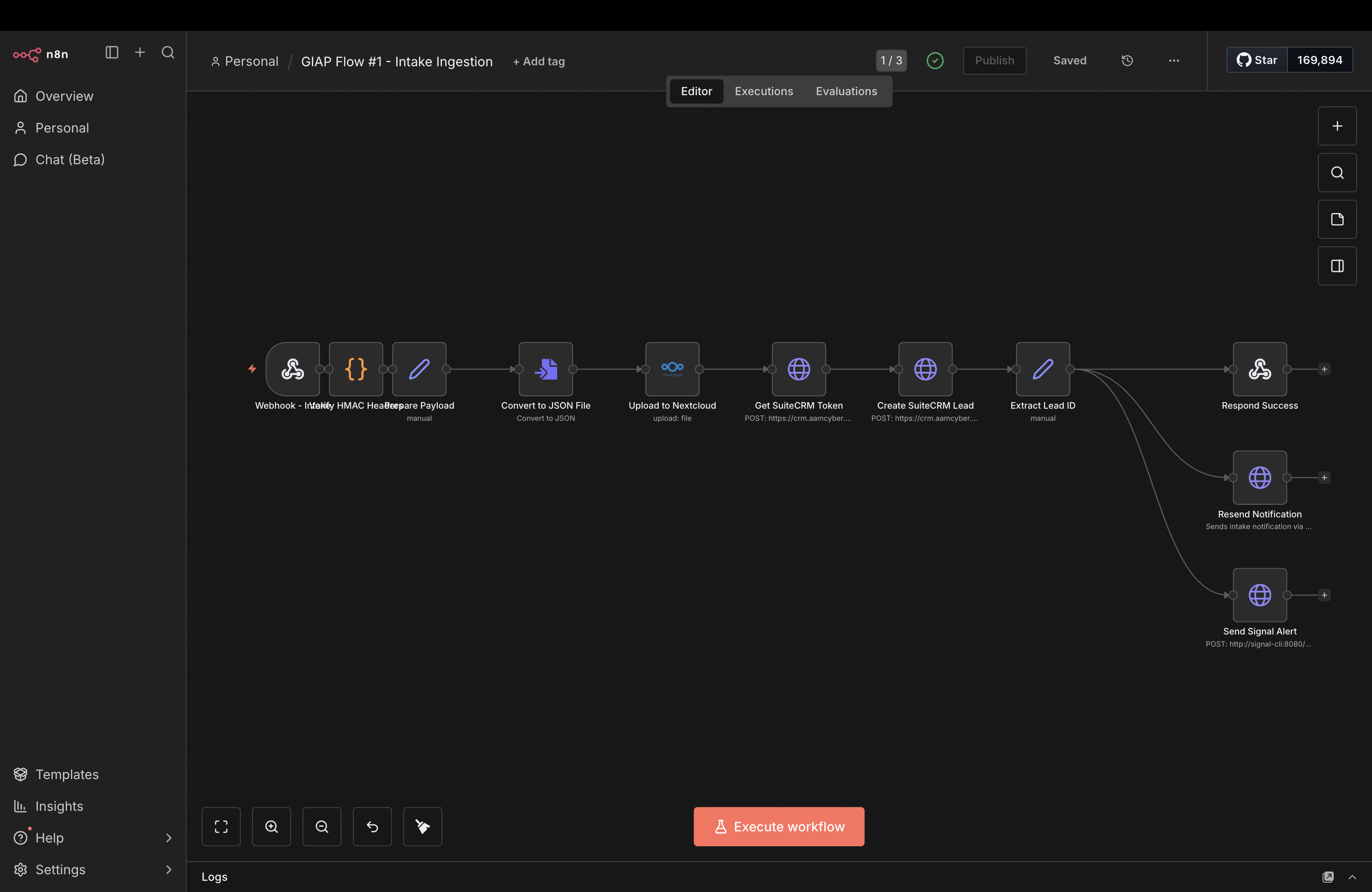 Flow #1 shows the complete intake pipeline: HMAC-authenticated webhook → JSON conversion → Nextcloud storage → SuiteCRM OAuth2 lead creation → email + Signal notifications.
Working Workflow: GIAP Intake Simple¶
The first n8n workflow is operational and logging intake submissions to Nextcloud:
flowchart TD
    subgraph WORKFLOW["GIAP Intake Simple Workflow"]
        direction LR
        A["Portal v2.2"]
        B["n8n"]
        C["Nextcloud WebDAV"]
    end
    D["Log File"]

    A -->|"POST /webhook/giap-simple"| B
    B -->|"HTTP Request PUT"| C
    C -->|"Output: /GIAP-Intakes/....json"| D

    style C fill:#f9f,stroke:#333,stroke-width:2px
    style D fill:#bbf,stroke:#333,stroke-width:2px
Figure: Simple intake workflow showing Portal v2.2 sending POST requests to n8n webhook, which then stores JSON logs to Nextcloud via WebDAV HTTP PUT.
Verified: End-to-end test successful (January 2026). Intake JSON files automatically created in Nextcloud GIAP-Intakes/ folder. 20+ consecutive successful workflow executions after Signal-CLI hardening.
Data Flow¶
flowchart TB
    subgraph PRE["PRE-ENGAGEMENT"]
        direction TB
        PORTAL["Intake Portal"] --> N8N1["n8n: Intake"]
        N8N1 --> NC1["Nextcloud JSON"]
        N8N1 --> CRM["SuiteCRM Lead"]
        N8N1 --> RESEND1["Resend: Notification"]
        CRM --> DS["DocuSeal"]
        DS --> N8N2["n8n: Signed Callback"]
        N8N2 --> RESEND2["Resend: Confirmation"]
    end

    DG["DEPOSIT GATE"]

    subgraph POST["POST-ENGAGEMENT"]
        direction TB
        CA["CISO Assistant"] --> N8N3["n8n: Assessment"]
        N8N3 --> NC2["Nextcloud Evidence"]
        NC2 --> POA["POAMAgent"]
        POA --> REM["Remediation"]
        REM --> VCISO["vCISO Cycle"]
    end

    DS --> DG
    DG --> CA
    VCISO -.-> CA

    style PRE fill:#e8f4ea,stroke:#2e7d32,stroke-width:2px
    style POST fill:#e0f2fe,stroke:#0284c7,stroke-width:2px
    style DG fill:#fff3e0,stroke:#ef6c00,stroke-width:3px
Figure: Complete data flow through GIAP. Pre-engagement (green) routes from intake portal through n8n to Nextcloud, SuiteCRM, and DocuSeal for signatures. Deposit gate (orange) separates phases. Post-engagement (blue) flows through CISO Assistant to evidence storage, POA&M generation, remediation tracking, and vCISO cycles.
POAMAgent — Custom POA&M Generator¶
No dedicated open-source POA&M generator exists. For a boutique consulting firm, custom tooling is the right choice:
| Approach | Cost | Integration | Portfolio Value |
|---|---|---|---|
| Commercial (Onspring, etc.) | $5K-50K/year | Generic | None |
| Custom POAMAgent | Dev time only | Native GIAP | "Built production compliance tooling" |
POAMAgent Capabilities¶
# POAMAgent outputs
poam_agent = {
    "inputs": ["ciso_assistant_gaps", "aam_unified_controls", "client_context"],
    "outputs": {
        "executive_summary": "1-page risk overview (PDF)",
        "detailed_poam": "Full remediation plan with milestones (MD/CSV/PDF)",
        "task_export": "Task list for remediation tracking (JSON)"
    },
    "templates": "Jinja2 → Markdown → WeasyPrint PDF",
    "branding": "AAM Cyber deliverable format"
}
Implementation Scope¶
| Component | Complexity | Status |
|---|---|---|
| CISO Assistant API query | Low | ⬜ Future |
| Severity/priority logic | Low | ⬜ Future |
| Jinja2 templates | Low | ⬜ Future |
| PDF generation | Medium | ⬜ Future |
Future: MCP Integration¶
GIAP™ can integrate with Claude and other AI assistants via Model Context Protocol (MCP) for natural language queries against GRC data:
| MCP Server | Data Source | Example Queries |
|---|---|---|
giap-crm | SuiteCRM | "Show all pending intakes" / "What's the engagement status for Client X?" |
giap-controls | CISO Assistant | "Run a quick SOC 2 gap check" / "What frameworks fit this client?" |
giap-evidence | Nextcloud | "Show the signed NDA for Client X" / "What evidence is missing for CC6.1?" |
giap-poam | POAMAgent | "Generate a POA&M for Client X" / "What are the top 5 high-risk items?" |
Example Conversation¶
User: New prospect came in — healthcare practice, 25 employees, M365 + on-prem EHR.
      Quick assessment before our sales call?

Claude: [Reads giap://controls/frameworks/hipaa/quick-assessment]
        [Reads giap://controls/frameworks/soc2/quick-assessment]

Quick Assessment for Healthcare Practice:

Recommended Frameworks: HIPAA (required), SOC 2 (recommended for vendors)

Likely Gaps (based on profile):
- §164.312(a) Access Control — EHR access reviews needed
- §164.308(a)(1) Risk Analysis — Likely missing formal risk assessment
- CC6.2 Logical Access — M365 MFA status unknown

Suggested Engagement: HIPAA Security Rule assessment + SOC 2 readiness
Estimated Scope: 40-60 hours

Ready to create intake in SuiteCRM?
Technology Stack¶
| Layer | Technology | Purpose | Status |
|---|---|---|---|
| Frontend | Static HTML/JS | Pre-intake wizard (v2.2, security hardened) | ✅ Deployed |
| Frontend | React 18 + Vite 5 | Full-featured GIAC UI (13 sections, 67 files, demo + real mode) | ✅ Deployed |
| Backend | FastAPI + SQLAlchemy | GIAC API with token validation, rate limiting, IP audit logging | ✅ Hardened |
| Orchestration | n8n | Workflow automation, notifications | ✅ Running |
| GRC Platform | CISO Assistant | Assessments, risk, controls, 100+ frameworks | ✅ Running |
| Files | Nextcloud | Evidence vault, document storage | ✅ Running |
| CRM | SuiteCRM | Client records, intake tracking | ✅ Running |
| Signatures | DocuSeal (self-hosted) | Engagement letters, DPAs, BAAs, NDAs | ✅ Deployed |
| Resend | Transactional notifications, status alerts | ✅ Working | |
| Signal | signal-cli REST API | Encrypted alerts, command bot (11 commands), security hardened | ✅ Hardened |
| Monitoring | Uptime Kuma | Public status page, service health, incident tracking | ✅ Running |
| POA&M | POAMAgent (custom) | Branded deliverables, multi-format output | ⬜ Future |
| Proxy | Nginx Proxy Manager | TLS termination, routing | ✅ Running |
| DNS | Cloudflare | DNS management, DDoS protection, WAF | ✅ Running |
| Infrastructure | Proxmox LXC/VM | Isolated service VMs | ✅ Running |
| Access | Tailscale | Admin routes restricted by CGNAT + ACL | ✅ Running |
CISO Assistant — Single GRC Platform¶
CISO Assistant serves as the single GRC platform for both pre-engagement and post-engagement work:
| Capability | Description |
|---|---|
| 100+ Frameworks | Pre-loaded SOC 2, NIST CSF, CIS v8, HIPAA, ISO 27001, and more |
| API-First | Full REST API for automation and integration |
| Risk Management | Risk registers, assessments, treatment plans |
| Control Mapping | Auto-mapping across frameworks |
| Gap Analysis | Identify compliance gaps with scoring |
| Evidence Collection | Link evidence to controls |
| YAML/JSON Export | Clean export formats for reporting |
Why CISO Assistant over Eramba CE?
| Factor | CISO Assistant | |
|---|---|---|
| API | ✅ Full REST API | ❌ No API (manual only) |
| Frameworks | 100+ pre-loaded | Limited |
| Automation | ✅ n8n compatible | ❌ Manual imports |
| Overhead | Low | High |
Framework Coverage¶
CISO Assistant provides 100+ pre-loaded frameworks with auto-mapping. Current implementation depth for GIAP™ intake workflows:
| Framework | Implementation | Notes |
|---|---|---|
| CIS Controls v8 | 80% | IG1/IG2 complete, targeted IG3 controls |
| NIST CSF 2.0 | 80% | All 5 functions, moderate depth |
| HIPAA | 80% | Security Rule strong, Privacy Rule partial |
| SOC 2 | 70% | CC6/CC7 focus, other criteria partial |
| NIST 800-53 | 60% | Moderate baseline started |
| CPRA | Full | California privacy requirements mapped |
| ISO 27001 | Full | Control mapping via CISO Assistant |
| PCI-DSS | Full | Control mapping via CISO Assistant |
| GDPR | Full | Control mapping via CISO Assistant |
| AAM Unified Controls | Proprietary | Cross-framework normalization layer |
HIPAA Coverage¶
GIAP™ supports HIPAA Security Rule and Privacy Rule compliance for healthcare clients and business associates:
| HIPAA Requirement | Implementation | AAM Control |
|---|---|---|
| §164.312(a) Access Control | RBAC, unique user IDs, auto-logoff | AAM.ACCESS-01 |
| §164.312(b) Audit Controls | Append-only logs, activity monitoring | AAM.AUDIT-01 |
| §164.312© Integrity | SHA-256 checksums, tamper detection | AAM.INTEG-01 |
| §164.312(d) Authentication | MFA enforcement, credential management | AAM.AUTH-01 |
| §164.312(e) Transmission Security | TLS everywhere, encrypted transit | AAM.TRANS-01 |
| §164.308(a) Security Management | Risk analysis, sanctions, review | CISO Assistant Risk |
| §164.310 Physical Safeguards | Facility access, workstation security | Policy documentation |
Industry Profiles¶
GIAP™ intake schema includes jurisdiction-aware, industry-specific modules with auto-detected compliance requirements:
| Industry | Compliance Requirements | GIAP™ Support |
|---|---|---|
| Law Firms | CA Bar Rules, ABA Formal Opinion 477R, client confidentiality | Jurisdiction-aware intake (CA/AZ/CONUS), evidence vault isolation |
| Healthcare | HIPAA Security/Privacy Rule, HITECH, BAA requirements | Auto-detect PHI flag, BAA templates in DocuSeal |
| SaaS/Technology | SOC 2 Type II, vendor security questionnaires | TSC mapping, evidence collection workflows |
| Financial Services | GLBA, state regulations, PCI-DSS (if payment) | Multi-framework mapping, audit trail |
| Government Contractors | NIST 800-53, CMMC, FedRAMP (if cloud) | Federal baseline controls, CUI handling |
| HNWI/Public Figures | Privacy-first, minimal data retention, OPSEC | Data minimization, encrypted storage, access logging |
PropTech/IoT Compliance (Emerging Use Case)¶
GIAP™ extends to PropTech and IoT vendor compliance — an emerging challenge for regulated workspaces operating in smart buildings or residential environments:
| Challenge | GIAP™ Solution |
|---|---|
| IoT vendor deploys cloud-managed devices (locks, sensors, thermostats) | Vendor intake workflow captures architecture and capabilities |
| Regulated workspace needs specific controls (admin access, audit logs, telemetry limits) | Control requirements mapped to NIST/CIS/SOC2 criteria |
| Vendor architecture may not support required controls | Gap analysis documents vendor limitations vs compliance requirements |
| Need defensible decision trail | Evidence pipeline captures vendor docs, policies, communication timeline |
| Exception or accommodation needed | Compliance exception workflow with technical justification |
PropTech Compliance Workflow:
flowchart LR
    subgraph INTAKE[VENDOR INTAKE]
        VI[Vendor Info]
        PP[Privacy Policy]
        TC[Technical Capabilities]
    end

    subgraph ANALYSIS[GAP ANALYSIS]
        CR[Control Requirements]
        GA[Gap Assessment]
        RS[Risk Score]
    end

    subgraph OUTPUT[DECISION]
        RM[Risk Memo]
        ER[Exception Request]
        ET[Evidence Trail]
    end

    VI --> CR
    PP --> GA
    TC --> GA
    CR --> GA
    GA --> RS
    RS --> RM
    RS --> ER
    RM --> ET
    ER --> ET

    style INTAKE fill:#e8f4ea,stroke:#2e7d32
    style ANALYSIS fill:#fff3e0,stroke:#ef6c00
    style OUTPUT fill:#e0f2fe,stroke:#0284c7
Figure: PropTech vendor compliance workflow. Vendor intake (green) captures vendor info, privacy policy, and technical capabilities. Gap analysis (orange) maps control requirements to assessment and risk scoring. Decision output (blue) produces risk memos, exception requests, and evidence trails.
Why this matters: Remote work and regulated home offices are increasing. Smart building technology creates compliance conflicts that traditional GRC tools don't address. GIAP™ provides a structured approach to vendor risk assessment for IoT deployments.
AAM Unified Controls¶
Proprietary control framework that normalizes intake responses and maps to all supported frameworks:
framework: AAM-Custom-GRC
client: Healthcare Practice A
version: 1.0
controls:
  - id: AAM.ACCESS-01
    status: partial
    notes: Offboarding not documented
    frameworks:
      SOC2: CC6.2
      NIST-CSF: PR.AC-1
      CISv8: 6.2
      HIPAA: §164.312(a)(1)
Control Mapping Examples¶
| Control Area | Implementation | Mapped Frameworks |
|---|---|---|
| Access Control | RBAC on portal/CRM; least-privilege folders; MFA enforcement | SOC 2 CC6, NIST PR.AC, CIS 5.x/6.x, HIPAA §164.312(a) |
| Data Protection | TLS enforcement; encryption at rest; email security (DKIM/DMARC) | SOC 2 CC6, NIST PR.DS, CIS 3.x, HIPAA §164.312(e) |
| Integrity & Retention | SHA-256 checksums on upload; retention schedule; logged deletion | SOC 2 CC3/CC8, NIST PR.DS, HIPAA §164.312© |
| Audit Logging | Append-only logs; immutable audit trail; workflow step logging | SOC 2 CC7, NIST DE.CM, CIS 8.x, HIPAA §164.312(b) |
| Authentication | MFA, unique IDs, credential rotation | SOC 2 CC6, NIST PR.AC, HIPAA §164.312(d) |
| Provisioning | Onboarding/offboarding runbooks; periodic access review | SOC 2 CC6, NIST PR.AC, HIPAA §164.308(a)(3) |
| Risk Management | Risk assessments, risk register, treatment plans | NIST ID.RA, HIPAA §164.308(a)(1) |
Target Metrics¶
| Metric | Manual Process | GIAP™ Automated | Improvement |
|---|---|---|---|
| Pre-engagement assessment | 2-3 hours | 15 minutes | ~90% reduction |
| Intake processing | 2-3 hours | 15 minutes | ~85% reduction |
| POA&M generation | 4+ hours | 10 minutes | ~95% reduction |
| Audit prep | 4+ hours | 30 minutes | ~87% reduction |
| Risk assessment | Full day | 2 hours | ~75% reduction |
| Control mapping | Manual spreadsheet | Auto YAML export | 100% coverage |
| Evidence retrieval | Navigate folders | Natural language query | ~70% time saved |
Metrics represent design targets based on architecture specifications.
vCISO Continuous Compliance¶
GIAP™ supports 90-day recurring assessment cycles for vCISO engagements:
- CISO Assistant → Delta assessment questionnaire, control re-testing
- n8n Workflow → Trigger assessment, collect evidence, update records
- Nextcloud → Evidence vault updates
- POAMAgent → Updated POA&M (new gaps vs. closed items)
- SuiteCRM → Timestamped audit trail, billing trigger
Business Impact: Enables recurring vCISO engagements with automated quarterly reviews and continuous compliance monitoring.
Implementation Status¶
| Component | Status | Notes |
|---|---|---|
| Architecture design | ✅ Locked | Streamlined single-GRC-platform design |
| Portal (Static) | ✅ Deployed | v2.2 with security hardening, WCAG 2.1 AA |
| n8n Orchestration | ✅ Running | 9 workflows operational |
| Flow #1 - Intake Ingestion | ✅ Active | Portal → HMAC webhook → SuiteCRM + Nextcloud |
| Flow #2 - DocuSeal Signed | ✅ Active | Signature webhook → Case status + notification |
| Flow #3 - CISO Sync | ✅ Active | Intake → CISO Assistant project creation |
| Flow #4 - Deposit Gate | ✅ Active | Polling every 5 min for deposit status |
| Flow #5 - Intake Complete | ✅ Active | Client + admin notifications on completion |
| Backup Automation | ✅ Active | Daily n8n + CISO Assistant backups |
| Signal Command Bot | ✅ Active | 12 commands, 30s polling, 5s execution (v3.8) |
| Nextcloud | ✅ Running | Evidence vault operational, WebDAV API working |
| SuiteCRM | ✅ Running | Lead + Case creation, custom status dropdown |
| CISO Assistant | ✅ Running | Primary GRC platform with 100+ frameworks |
| SMTP Relay | ✅ Deployed | Postfix container on port 587 |
| Email Notifications | ✅ Working | Resend API (SOC 2 compliant) |
| Signal Notifications | ✅ Working | Hybrid model: Signal + Email for all alerts |
| DocuSeal | ✅ Deployed | Template ID: 14 configured, callback workflow active |
| GIAC API (FastAPI) | ✅ Hardened | Rate limiting (5/15min), IP audit logging, 72h JWT expiry, token binding |
| GIAC UI (React) | ✅ Deployed | 13 sections, 67 files, demo + real mode |
| E2E Pipeline | ✅ Verified | 8 test leads processed: Deposit → Token → Submission → CISO → Email → Signal |
| POAMAgent | ⬜ Future | Custom POA&M generation |
| MCP Integration | ⬜ Future | AI-assisted queries |
Security Architecture¶
| Control | Implementation |
|---|---|
| Admin Access | Tailscale CGNAT allowlist (100.64.0.0/10) + ACL tags |
| RBAC | Server-side enforcement in FastAPI; UI is presentation-only |
| Audit Logging | Append-only, immutable audit trail |
| PHI/PII Protection | Masked/truncated in MCP responses; encrypted at rest; never exposed in full |
| TLS | Enforced everywhere; HSTS enabled |
| Secrets | Environment variables; never in code or logs |
| BAA Support | DocuSeal templates for Business Associate Agreements |
| Deposit Gate | No full intake work without signed engagement + deposit |
Portal Security Hardening (v2.2)¶
The intake portal underwent comprehensive security hardening with expert panel review:
| Category | Implementations |
|---|---|
| Input Validation | XSS prevention (stripHtml sanitization), RFC 5322 email validation |
| Anti-Abuse | 5-second rate limiting, honeypot field for bot detection |
| Accessibility | WCAG 2.1 AA compliant, skip navigation, ARIA live regions |
| Mobile UX | 48px touch targets, 16px font-size (prevents iOS zoom), 375px breakpoint |
| Compliance | CCPA/CPRA disclosures, COPPA children's privacy statement |
| Hardened Endpoint | Webhook URL hardcoded (eliminates localStorage injection vulnerability) |
Code Sample — Security Implementation:
// XSS Prevention - strips HTML tags to prevent injection
const stripHtml = (str) => {
  if (typeof str !== "string") return "";
  return str.replace(/<[^>]*>/g, "").trim();
};

// RFC 5322 compliant email validation
const isValidEmail = (email) => {
  const emailRegex = /^[a-zA-Z0-9.!#$%&'*+/=?^_`{|}~-]+@[a-zA-Z0-9](?:[a-zA-Z0-9-]{0,61}[a-zA-Z0-9])?(?:\.[a-zA-Z0-9](?:[a-zA-Z0-9-]{0,61}[a-zA-Z0-9])?)*$/;
  return emailRegex.test(email) && email.length <= 254;
};

// Rate limiting - 5 second throttle prevents form spam
let lastSubmission = 0;
const THROTTLE_MS = 5000;

// Honeypot - fake success for bots filling hidden field
if (error === "HONEYPOT") {
  showAlert("Thank you! Your request has been submitted.", "success");
  return; // Don't actually submit
}
Webhook Authentication (HMAC-SHA256)¶
Portal-to-n8n webhook communication uses HMAC-SHA256 signature verification to ensure request authenticity, payload integrity, and replay prevention:
sequenceDiagram
    participant P as Portal
    participant N as n8n Webhook

    P->>P: Build payload
    P->>P: Get timestamp (epoch ms)
    P->>P: Compute HMAC-SHA256
    P->>N: POST with X-GIAP-Timestamp and X-GIAP-Signature headers
    N->>N: Extract timestamp and signature
    N->>N: Recompute HMAC with same secret
    N->>N: Compare signatures
    N->>N: Verify timestamp less than 5 min old
    alt Valid
        N->>N: Process request
    else Invalid
        N->>P: Reject 401
    end
Figure: HMAC-SHA256 webhook authentication sequence. Portal builds payload, generates timestamp, computes HMAC signature, and sends POST with authentication headers. n8n webhook extracts timestamp/signature, recomputes HMAC, compares signatures, validates timestamp freshness (5-minute window), then processes or rejects the request.
Attack Prevention:
| Attack | How HMAC Stops It |
|---|---|
| Unauthorized submissions | Attacker doesn't know the signing secret |
| Replay attacks | Timestamp expires after 5 minutes |
| Payload tampering | Any modification invalidates the signature |
Code Sample — HMAC Signature Generation:
// Generate HMAC-SHA256 signature for webhook authentication
async function generateSignature(payload, secret) {
  const timestamp = Date.now();
  const message = `${timestamp}.${JSON.stringify(payload)}`;

  const encoder = new TextEncoder();
  const key = await crypto.subtle.importKey(
    'raw', encoder.encode(secret),
    { name: 'HMAC', hash: 'SHA-256' }, false, ['sign']
  );

  const signature = await crypto.subtle.sign('HMAC', key, encoder.encode(message));
  const hex = Array.from(new Uint8Array(signature))
    .map(b => b.toString(16).padStart(2, '0')).join('');

  return { timestamp, signature: `sha256=${hex}` };
}
Defense-in-Depth Limitation
For a public form, the signing secret is visible in browser DevTools (client-side JavaScript). This implementation raises the bar for attackers but isn't cryptographically bulletproof — true end-to-end security would require a backend proxy. This is an intentional trade-off: defense-in-depth protection without backend infrastructure overhead.
GIAC API Security Hardening (January 2026)¶
The GIAC API (FastAPI backend) implements production-grade security controls for token management and intake processing:
| Control | Implementation | CIS v8 Mapping |
|---|---|---|
| Rate Limiting | 5 requests per 15 minutes per IP (slowapi) | 13.1 |
| IP Audit Logging | All token generation attempts logged with IP, timestamp, outcome | 8.2, 8.5 |
| JWT Expiry | 72-hour token lifetime (reduced from 7 days) | 6.2 |
| Token Binding | intake_token + external_id passed through deposit flow | 6.3 |
Why these controls matter:
- Rate limiting prevents brute-force token enumeration and abuse
- IP audit logging enables forensic analysis of suspicious activity
- Shortened JWT expiry reduces window of token compromise
- Token binding ensures deposit workflow integrity (Flow #4 fix)
# Rate limiting with slowapi
from slowapi import Limiter
from slowapi.util import get_remote_address

limiter = Limiter(key_func=get_remote_address)

@app.post("/api/token")
@limiter.limit("5/15minutes")
async def generate_token(request: Request):
    # IP logged on every attempt
    logger.info(f"Token request from {request.client.host}")
    ...
Signal Integration¶
GIAP™ implements a hybrid notification model using both Signal and email for operational alerts and status monitoring.
Signal Command Bot¶
A dedicated Signal bot monitors the GIAP Alerts group and responds to 12 operational commands:
| Command | Function |
|---|---|
/help | List all available commands (organized by category) |
/ping | Quick alive check + service count |
/status | Service health with status indicators |
/test | Detailed diagnostics for all 6 GIAP services |
/uptime | 24-hour uptime with progress bars |
/pending | Leads awaiting deposit payment |
/today | Daily activity metrics |
/leads | Pipeline summary by status |
/backup | Backup schedule and automation info |
/lastbackup | Last 3 backup runs (LIVE from n8n API) |
/version | Bot version and configuration info |
/debug | Debug data counts for troubleshooting |
Notification Events¶
| Event | Signal | |
|---|---|---|
| New intake received | ✅ Admin | ✅ Admin |
| Engagement letter signed | ✅ Admin | ✅ Admin |
| Deposit received | ✅ Admin + Client | ✅ Admin |
| Intake complete | ✅ Admin + Client | ✅ Admin |
| Backup success | ⏸️ Disabled | ✅ Admin |
Technical Implementation¶
- Bot Infrastructure:
signal-cli-rest-apicontainer (bbernhard/signal-cli-rest-api:latest) - Registration: Primary device (not linked) — maintains persistent websocket connection
- Polling Interval: 30 seconds
- Execution Time: ~5 seconds per cycle (optimized from 275s in v3.7)
- API Version: signal-cli v0.13.x
- Group: GIAP Alerts (base64-encoded group ID)
- Architecture: v3.8 with chained Merge nodes and LAN IP routing
Architecture Evolution (v3.0 → v3.8):
- v3.5: Fixed race condition (multiple responses) using chained Merge nodes. Root cause: n8n Code nodes execute when ANY input arrives, not ALL. Solution: chain Merge nodes (mode: "append") to synchronize 5 parallel data sources.
- v3.7 → v3.8: Diagnosed 275-second execution time caused by Tailscale IP routing failure to Uptime Kuma. Fixed by switching to LAN IP (
192.168.8.177), reducing execution to ~5 seconds. - Primary Device Fix: Re-registered signal-cli as primary device (not linked) to maintain persistent websocket connection — linked devices lose connection when idle.
Chained Merge Pattern (v3.5+):
flowchart LR
    subgraph SOURCES["Data Sources"]
        SIG[Signal API]
        STAT[Status Check]
        HB[Heartbeats]
        BK[Backups]
        CRM[CRM Auth] --> LEADS[Leads Query]
    end

    subgraph MERGE["Chained Merge Pattern"]
        M1[Merge 1]
        M2[Merge 2]
        M3[Merge 3]
        M4[Merge 4]
    end

    subgraph OUTPUT["Processing"]
        CODE[Code Node]
        SEND[Send Response]
    end

    SIG --> M1
    STAT --> M1
    M1 --> M2
    HB --> M2
    M2 --> M3
    BK --> M3
    M3 --> M4
    LEADS --> M4
    M4 --> CODE --> SEND

    style SOURCES fill:#e8f4ea,stroke:#2e7d32
    style MERGE fill:#fff3e0,stroke:#ef6c00
    style OUTPUT fill:#e0f2fe,stroke:#0284c7
Figure: Signal bot v3.8 architecture solving async race conditions. Five data sources (Signal API, Status Check, Heartbeats, Backups, CRM/Leads) feed into chained Merge nodes (mode: append) that synchronize all inputs before processing. Final Code node handles routing logic and sends response.
Why this matters: Demonstrates n8n workflow architecture expertise, debugging complex async patterns, network troubleshooting (Tailscale vs LAN routing), Signal protocol knowledge (primary vs linked device), and production-grade operational tooling. The 275s → 5s optimization shows systematic root cause analysis.
Security Hardening (January 2026):
| Control | Implementation | CIS v8 Mapping |
|---|---|---|
| Network Isolation | Localhost binding (127.0.0.1:8080) — eliminates external attack surface | 12.2 |
| Persistence | Systemd service for Docker network persistence after reboots | 4.1 |
| Encrypted Backups | GPG-encrypted weekly backups with 5-backup retention | 11.3 |
| Container Networking | All 8 workflows migrated to Docker DNS (more resilient than IP) | 12.3 |
| File Permissions | chmod 700 on /opt/signal-cli-data | 3.3 |
Why Signal? End-to-end encryption, no vendor lock-in, mobile-first alerts for time-sensitive GRC operations. The hybrid model ensures redundancy — if email is delayed, Signal provides immediate notification.
Output Artifacts¶
POA&M Example¶
{
  "poam_id": "AAM-POAM-2025-0042",
  "client": "Healthcare Practice A",
  "generated": "2025-01-15T10:00:00Z",
  "generator": "POAMAgent v1.0",
  "frameworks": ["HIPAA", "SOC2"],
  "summary": {
    "total_items": 12,
    "high": 3,
    "medium": 6,
    "low": 3
  },
  "items": [
    {
      "id": "POAM-001",
      "control": "AAM.ACCESS-01",
      "issue": "No documented offboarding process",
      "severity": "High",
      "recommended_action": "Implement offboarding checklist and admin access revocation SOP",
      "target_date": "2025-02-01",
      "frameworks": ["SOC2_CC6.2", "HIPAA_164.312(a)"],
      "ciso_assistant_task_id": "CA-TASK-4521"
    }
  ]
}
Intake JSON Schema¶
{
  "intake_id": "GIAP-2025-0042",
  "phase": "post-engagement",
  "client": "Healthcare Practice A",
  "industry": "Healthcare",
  "size": 25,
  "tech_stack": ["M365", "EHR System", "Nextcloud"],
  "risk_profile": "PHI-heavy",
  "frameworks": ["SOC2", "NIST-CSF", "HIPAA"],
  "pre_engagement": {
    "ciso_assistant_assessment_id": "CA-2025-0042",
    "quick_gaps_identified": 5,
    "deposit_received": true,
    "engagement_signed": "2025-01-10T14:30:00Z"
  },
  "post_engagement": {
    "ciso_assistant_project_id": "CA-PRJ-2025-0042",
    "full_gaps_identified": 12,
    "poam_generated": true
  }
}
Skills Demonstrated¶
| Category | Skills |
|---|---|
| Architecture | Multi-agent orchestration, two-phase workflow design, API-first design, MCP protocol |
| GRC | Framework mapping, risk management, control assessment, POA&M generation, evidence pipelines, vCISO delivery |
| GRC Platforms | CISO Assistant administration, 100+ framework coverage, API-first integration, multi-platform orchestration |
| Workflow Automation | n8n workflow design, webhook integration, WebDAV API, JSON data pipelines, Signal bot integration, async race condition resolution, performance optimization (275s → 5s) |
| Custom Tooling | POAMAgent development, Jinja2 templating, PDF generation, API integration |
| Healthcare Compliance | HIPAA Security Rule, Privacy Rule, BAA management, PHI protection |
| AI/LLM | MCP server design, natural language GRC queries, LLM-assisted documentation |
| Backend | FastAPI, SQLAlchemy, Alembic migrations, RBAC enforcement, audit logging |
| Frontend | Static HTML/JS (security hardened), React, Vite, API consumption patterns |
| Application Security | XSS prevention, input sanitization, rate limiting, honeypot bot detection, WCAG 2.1 AA |
| API/Webhook Security | HMAC-SHA256 authentication, replay attack prevention, timestamp validation, cryptographic integrity |
| DevOps | Proxmox virtualization, Tailscale networking, GitHub Actions CI, Nginx Proxy Manager, Uptime Kuma monitoring |
| Security | Append-only audit logs, PHI/PII protection, TLS enforcement, least-privilege design |
What This Demonstrates (Agentic GRC Layer Capabilities)¶
- Senior-level systems architecture — Multi-agent orchestration with clear two-phase workflow
- Operational automation — End-to-end intake workflow with n8n, webhooks, and WebDAV integration; Signal bot v3.8 resolved async race conditions and achieved 98% execution time reduction (275s → 5s) through systematic network troubleshooting
- Security engineering discipline — Comprehensive portal hardening with XSS prevention, rate limiting, and WCAG 2.1 AA compliance
- API security maturity — HMAC-SHA256 webhook authentication with replay attack prevention and cryptographic integrity verification
- CI/CD in production — GitHub Actions lint/test gates and portal deploy workflow with secrets checks and secure remote sync
- Right tool for the job — CISO Assistant for both speed and depth with 100+ frameworks
- Custom tooling capability — POAMAgent built in-house for branded deliverables
- Enterprise GRC platform experience — CISO Assistant for production risk, compliance, and control management
- AI/LLM integration expertise — MCP protocol for natural language GRC queries
- Healthcare compliance depth — HIPAA Security/Privacy Rule implementation
- Production-grade security — RBAC, audit logging, PHI protection, deposit gate
- Operational transparency — Public status page (status.aamcyber.com) demonstrates "practice what we preach" approach to availability monitoring
- Emerging vertical expertise — PropTech/IoT compliance for regulated workspaces
- GRC domain depth — Cross-framework mapping, POA&M generation, evidence pipelines
- Full-stack capability — Static portal + n8n workflows + infrastructure automation
- Consulting delivery model — Productized vCISO service with 90-day cycles
Pairs with Cloud Control Pack for cloud governance and TraceLock™ for RF/physical security — demonstrating end-to-end security engineering capability.
See It In Action
Don't just read about it — experience the production system yourself.
GIAP™ demonstrates how AI-driven compliance workflows can be governed as a production security system — not merely automated as a convenience tool.