Security Decision Architecture (SDA)
Security programs generate enormous volumes of telemetry, alerts, and compliance data. The objective is not alert volume; it is defensible security decisions.
Security Decision Architecture (SDA) defines the technical implementation layer that transforms heterogeneous telemetry into structured analysis, governance inputs, and actionable security decisions. SDA is not a competing framework to SDOM; it is the architecture pipeline SDOM depends on.
This model connects telemetry systems, detection engineering, governed automation workflows, and governance processes into one decision pipeline.
The problem with traditional security architectures
Many security programs are organized around tools rather than decisions. Common failure modes include:
- Alert-centric operations. Teams optimize for detection volume rather than decision quality.
- Fragmented tooling. Telemetry systems, automation workflows, and governance processes operate in silos.
- Compliance disconnected from operations. Governance frameworks are applied after operations rather than integrated into them.
These gaps create environments where organizations collect large amounts of security data but still struggle to determine what action should be taken.
Security Decision Architecture addresses this by structuring the flow from telemetry to decisions.
Security decision architecture pipeline
SDA organizes security systems into a layered decision pipeline with a governance feedback loop. Security decisions feed back into detection tuning, automation policy, and governance refinement — creating a closed-loop architecture rather than a one-way data flow.
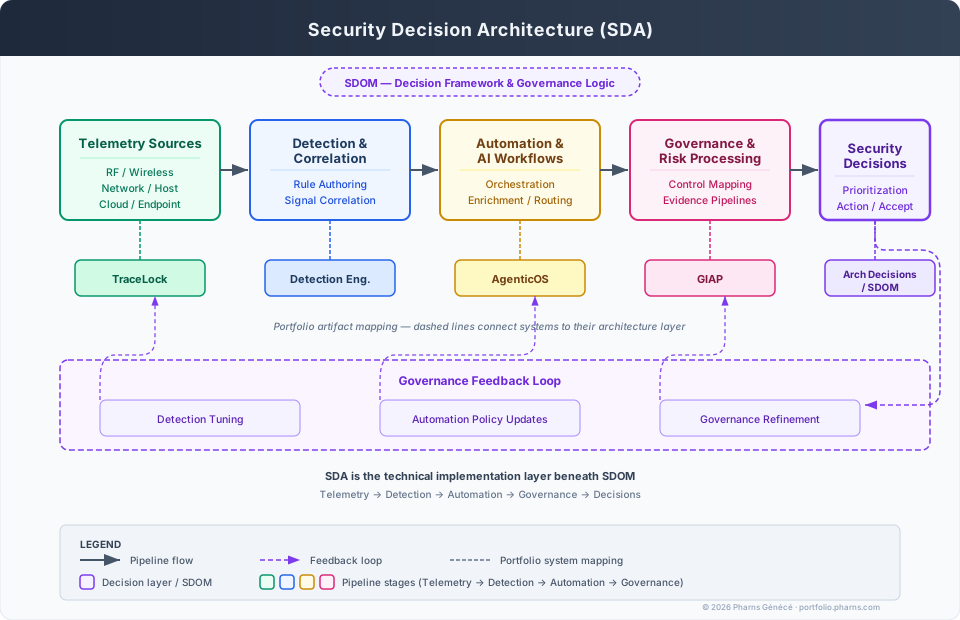
Security Decision Architecture pipeline: telemetry flows through detection, automation, and governance into defensible security decisions. The governance feedback loop ensures decisions refine upstream detection tuning, automation policy, and governance controls. Portfolio systems are mapped to their corresponding architecture layers.
Each layer plays a distinct role in transforming raw security signals into structured decision inputs.
Mermaid source (simplified pipeline view)
flowchart LR
    A[Telemetry Sources] --> B[Detection and Correlation]
    B --> C[Automation and AI Workflows]
    C --> D[Governance and Risk Processing]
    D --> E[Security Decisions]

    subgraph Telemetry
        A
    end

    subgraph Detection
        B
    end

    subgraph Automation
        C
    end

    subgraph Governance
        D
    end

    subgraph Decisions
        E
    end
Architecture layers
Telemetry systems
Security telemetry provides the raw signals used by detection systems.
Examples include:
- wireless telemetry and RF monitoring
- network telemetry
- system logs and endpoint signals
- environmental and sensor inputs
Within this portfolio, TraceLock demonstrates telemetry fusion across multiple RF domains.
Detection engineering
Detection engineering transforms raw telemetry into correlated signals and threat indicators.
This layer includes:
- detection rules
- correlation logic
- anomaly detection
- signal prioritization
Detection engineering converts telemetry into structured observations that feed downstream workflows.
Automation and AI workflows
Automation platforms orchestrate the analysis and routing of security signals.
Examples include:
- automated enrichment workflows
- incident response automation
- AI-assisted signal classification
- operational orchestration
Within this portfolio, AgenticOS demonstrates governance-aware automation of operational workflows.
Governance and risk processing
Security governance systems transform operational outputs into structured risk inputs.
This includes:
- compliance frameworks
- risk scoring
- governance workflows
- audit evidence collection
Within this portfolio, GIAP demonstrates automation of governance and risk workflows.
Security decisions
The final layer converts governance outputs and operational intelligence into actionable decisions.
Examples include:
- risk prioritization
- control investment decisions
- architecture changes
- operational response
Within this portfolio, these decisions are documented through architecture decision records.
Relationship to the Security Decision Operating Model (SDOM)
SDA is the technical implementation layer under SDOM.
Conceptually:
Security Decision Operating Model (SDOM)
Decision framework and governance logic
            ↓
Security Decision Architecture (SDA)
Technical systems that produce decision inputs
SDOM defines decision logic and governance structure. SDA implements the telemetry, detection, automation, and governance pipeline that produces those decision inputs.
Capability signals demonstrated in this portfolio
This architecture model reflects capability domains demonstrated by portfolio artifacts:
- Security telemetry fusion
- Detection engineering and signal correlation
- Automation and AI-assisted workflows
- Governance and compliance automation
- Architecture-driven security decision processes
These capabilities support decision-driven security operations rather than tool-centric security programs.